

Are we rolling, are we not rolling? Are we sick of hearing about rolling? We should be. There is no science behind it.

From ST Pro Tech, deep bows of thanks and respect to the trainers at Motus for getting this published:
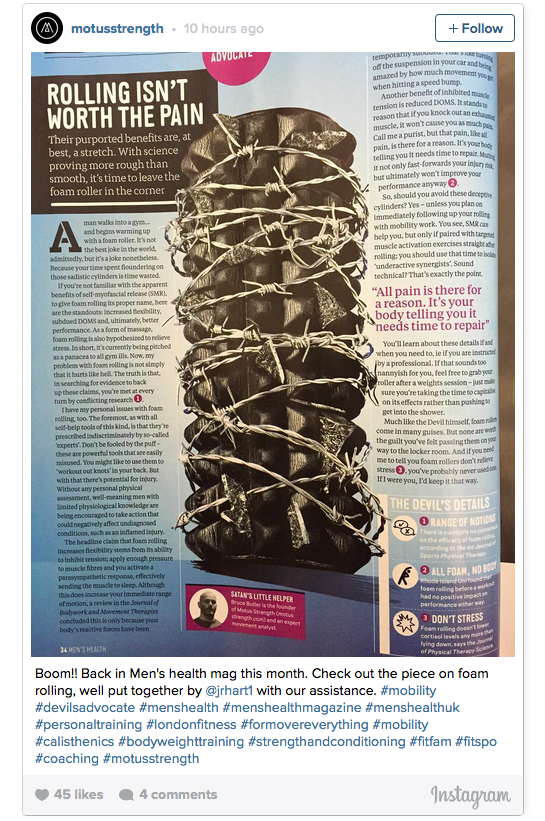
Jumping from One Study to Another on Stepping Stones of Anectdotal Evidence
Anecdotal evidence is when something happens once. Just because something happens in the lab doesn’t make it a finding. Most academic studies are for specific and highly restricted cohorts and due to our limitations in measurement, restricted to only very small aspects of the overall kinetic chain or specific physiological states. Like when you’re high. That’s a physiological state.
But in spite of the practical limitations in research findings, it is standard practice for humans (including researchers) to Jump to Conclusions – right down into the pit of exercise despair.

Image: One Flew Over the Cuckoo’s Nest with Tobias Funk Photobomb
While academic studies and practice are limited, most commercial publications are even worse. They are not subject to peer review and are often sponsored by product manufacturers and business interests that benefit from the alleged study findings.
Leading the charge! A slew of hot exercise models!

Foam Rolling & Fads – All F Words
This is what Men’s Fitness posted about foam rolling back on May 22, 2015. You can’t miss it. Their team of 20yr old SEO optimization experts will make sure that this pithy blurb is the first thing you see on a search engine query on “foam rolling”.
The blurb is titled “The Truth About Foam Rolling”. It refers to studies and findings that don’t exist. But it reads as if it is a reliable finding.
We can use common sense to show how useless this is in a jiffy:
- “most trainers”
- Who are “most trainers”? What are their credentials? Did they survey all trainers to calculate most? Do they even care?
- “a study”
- What study? What’s the title and publication date? Have the findings been worked and tested in the field? Can I get the number of that hot exercise model?
- “rolling out”
- What does “rolling out” even mean? Are we rolling on muscle? Are we rolling on connective tissue? Are we rolling a joint and smoking it too?
- “range of motion” (ROM)
- Technically, ROM refers to action around a joint. Did this magical study cover every joint? Were the conditions repeatable for different biochemical states such as fatigue or stress? Do you guys just like using the words Range of Motion?
- “relieve soreness”
- Was the exercise too intense? Is the soreness from overexertion? Wait, is the objective ROM or pain relief? Is there an objective here at all?
** updated 6/19/16 ** – There was originally a link to the article referenced above in the original post — STPro just pulled the link *** as my buddy in SEO (search engine) optimization warned STPro that these big media sites can use big money nefarious tactics to bury this article. The Men’s Fitness article is easy to find – they made sure of that – you can just google for “Foam Rolling” – it will pop up front and center in big red letters — it’s an “SEO” article – meant to drive traffic to their site, but lacking in content. In theory, Google’s search engine removes these “hack” articles. Yeah, and Foam Rolling is based on a “study” that magically, never appears when we google for “foam rolling”.
Goodbye, Prison Mattress – Hello, Biomechanics

Just a few terms we should know to defend ourselves:
- Mobility refers to joints
- Flexibility refers to muscles
- Range-of-motion refers to joints
Reality of where we are scientifically:
- Mobility is a complicated mechanical process
- Muscle length is a complicated neurological process
- Muscles are sensitive to complex physiological states
- Experts do not agree
Hot new trends we are still studying:
- Fascia surrounds all muscle compartments and impacts range of motion
- Fascia has the tensile strength of 300lbs
- Taking out all the soft tissue, fascia alone will hold the shape of the human body
- We know it does things, but we’re not sure what
We Can Solve the Problem Ourselves – Train for Gains, Not Joint Pain
- Awareness that our body has the processes to manage itself if we train it right
- There is no quick and easy fix involving foam
- Mobility and flexibility take years to develop
- Mobility and flexibility are also a function of their physiological environment – hormones, what we eat etc.
- Incorporate dynamic flexibility into workouts immediately
- Free and Easy Examples:
- bodyweight squats
- spiderman (gecko) crawl
- Parkour ground based moves here: Parkour Master Ryan Ford’s Channel
- Free and Easy Examples:
- Adopt a synergistic workout routine
- Load joints from dynamic angles for ROM & Dynamic Flexibility
- Add plyometric movements with dynamic stretches into workouts
- Learn new moves beyond static and routinized routines
- Test yourself with a cross-punch and roundhouse kick: Studio T Pro Ninja Workout
- Adopt a synergistic training mindset. Plan out new routines. Studio T Pro Edition is a new site with a bold mission for training that doesn’t send you down the pit of joint despair: Mission DIY Synergy – Be Your Own Expert
- Load joints from dynamic angles for ROM & Dynamic Flexibility
Load joints from dynamic angles for ROM & dynamic flexibility
Example “The Antonio Brown” an advanced pilates move for skill position athletes.

Add plyometric movements with dynamic stretches into workouts
Example “Rocky Plyo Single-Arm Pushups”

 Don’t let em do it to ya
Studio T Pro Edition is dedicated to professional training using synergistic routines incorporating biomechanics into applied practice. We are on a never ending mission for excellence.
The Mission Is Underway. The Plan: Synergistic Training
Feedback matters. Get at me. Share & like, comment and email questions. Play stump the trainer with a question. Click to get things started: Get At Me…
Copyright Studio T, LLC 2016
 STPro
STPro 